
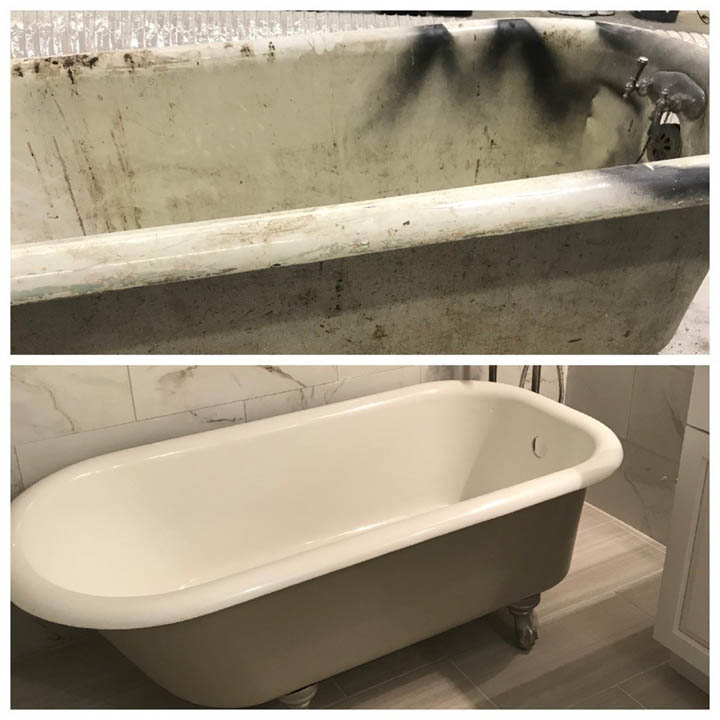
Porcelain Bathtub Restoration: What It Costs, How It Works, and When It Makes Sense
June 14, 2026
Bathtub Refinishing in Elgin, IL: A Homeowner’s Guide by House Age and Tub Type
For most Elgin homes, refinishing the existing tub is the cheaper and less disruptive fix: a professional job typically runs a few hundred dollars, takes about half a day, and the tub is back in use within 24 hours. A full tear-out and replacement usually costs $2,000 to $4,000 or more once demolition, plumbing, and new tile are counted. Whether refinishing is the right call depends heavily on when your house was built, because Elgin’s housing stock spans more than 150 years and each era installed a different kind of tub.
Elgin’s median home was built in 1977, but that average hides a split city: nearly 1 in 5 homes predates 1940, while about 1 in 5 was built after 2000 on the far west side. This guide walks through what that means for your bathroom, what refinishing costs here, and when you should skip it.
Quick answers for Elgin homeowners
- Pre-1940 homes (18.9% of Elgin housing): Usually cast iron. Refinishing is almost always the better move; removal often means cutting the tub apart or wrecking plaster walls.
- 1960s-70s homes (24.5%): Steel or cast iron, often in pink, blue, avocado, or harvest gold. Refinishing turns them white without touching the plumbing.
- 1980s-90s homes (24.0%): Mostly fiberglass or acrylic tub-shower units. Good candidates if the floor is solid and there are no active leaks.
- 2000-and-newer homes (21.1%): Many tubs don’t need refinishing yet. A deep clean may be all you need.
- Turnaround: About half a day for a tub, a full day for tub plus tile, back in service in 24 hours.
What Do Elgin Homeowners Typically Pay to Refinish a Tub?
Expect a standard porcelain, steel, or fiberglass tub to cost in the low-to-mid hundreds to refinish in the Chicago suburbs, with clawfoot tubs and tub-plus-tile jobs costing more. Replacement is where costs climb fast, especially in Elgin’s older homes, where the tub is often boxed in by plaster walls and a 1920s floor system. The table below uses typical Chicagoland ranges; your quote depends on tub condition, chip and crack repair, and whether a previous coating has to be stripped.
| Tub Type | Typical Refinishing | Typical Replacement | Main Tradeoff |
|---|---|---|---|
| Built-in cast iron (pre-1940s) | $350-$600 | $2,500-$5,000+ | Replacement means hauling 300+ lb of iron down old stairs and re-tiling |
| Clawfoot | $500-$1,200 | $3,000-$8,000+ | Exterior and feet can be refinished too; reproductions rarely match the originals |
| Enameled steel (1950s-70s) | $350-$600 | $1,500-$3,500 | Steel flexes and chips more than iron, so expect repairs before coating |
| Fiberglass/acrylic tub-shower unit (1980s-90s) | $350-$600 | $2,000-$4,000 | One-piece units often can’t leave the room without cutting walls |
| Tub plus surrounding tile | $600-$1,000 | $4,000-$8,000+ | Changes the color of the tile and grout, not the tile layout |
Here is the break-even in plain numbers. On a $3,500 replacement, refinishing at $500 saves $3,000. If the refinished surface lasts 10 years (the length of Aarco’s written guarantee), that works out to about $50 a year. Even if you refinished twice over 20 years, you would spend roughly $1,000 against $3,500 or more for one replacement.
Why Is Elgin’s Old Housing Stock Such a Good Fit?
Elgin kept more of its early-1900s houses than most Chicago suburbs, and those houses still have the heavy cast iron tubs that refinish best. The Elgin Historic District alone covers 206 acres and 697 buildings, roughly bounded by Villa, Center, Park, Liberty, and Channing Streets, and it was listed on the National Register of Historic Places in 1983. Add the Spring-Douglas Historic District, the Elgin National Watch historic district, and the Gifford Park neighborhood east of the Fox River, and a large share of the near-downtown housing predates World War II.
Elgin is also one of the best places in the country to find Sears kit houses. Architectural historian Rebecca Hunter confirmed 214 Sears homes in Elgin during a survey that ran from 1997 to 2004, with examples on Hamilton Street, Channing Street, Wing Park Boulevard, Crighton Avenue, and Orange Street, built between about 1913 and 1929. Elgin skipped the teardown wave that replaced many of these small houses in Hinsdale and Glen Ellyn. Sears kits shipped with plumbing fixtures, so some of these homes still have tubs that are 100 years old.
Those tubs are worth keeping. A built-in cast iron tub typically weighs 250 to 400 pounds, and in a 1920s house it usually sits under a tiled or plastered wall. Pulling one out often means breaking it with a sledgehammer, opening the wall, and rebuilding the tile line. Refinishing leaves the walls alone and keeps a period fixture that would be expensive to reproduce.
Which Tub Does Your Elgin House Probably Have?
The quickest way to estimate your options is to match your home’s construction era to the tub that builders of that era installed. We cross-referenced the U.S. Census Bureau’s American Community Survey (2019-2023 five-year estimates) year-built data for Elgin with the tub materials most common in each period. The result is a rough map of what’s sitting in Elgin bathrooms right now.
| Era Built | Share of Elgin Homes | Most Common Tub | Typical Problem | Refinishing Verdict |
|---|---|---|---|---|
| Before 1940 | 18.9% | Cast iron built-in or clawfoot | Worn-through glaze, rust at the drain, rough bottom | Strong fit |
| 1940-1959 | 11.4% | Cast iron, some enameled steel | Dull finish, chips, stains that won’t scrub out | Strong fit |
| 1960-1979 | 24.5% | Enameled steel or cast iron in period colors | Dated color, chipping on steel tubs | Strong fit (color change) |
| 1980-1999 | 24.0% | Fiberglass or acrylic tub-shower unit | Chalky, yellowed gelcoat; stress cracks in the floor | Good fit if the base is solid |
| 2000 and later | 21.1% | Acrylic tubs, garden and soaking tubs | Usually cosmetic wear only | Often not needed yet |
Two takeaways. First, roughly 55% of Elgin homes were built before 1980, when cast iron and enameled steel were standard, so most older Elgin tubs are the kind that refinish well. Second, the 1980s-90s fiberglass units in subdivisions east and west of Randall Road are now 25 to 45 years old, which is exactly when gelcoat starts to chalk, yellow, and develop hairline cracks.
How Does Elgin’s Hard Water Affect a Refinished Tub?
Elgin’s water is hard, and hard water is the most common reason a refinished tub looks tired before it should. The city draws from both the Fox River and deep groundwater wells, treated at the Riverside plant (online since 1982) and the Airlite well-water plant. The system serves roughly 108,000 people, including wholesale customers in Sleepy Hollow and Bartlett. Water-treatment companies that test local taps report hardness around 18 grains per gallon, which is in the “very hard” range. The City of Elgin’s annual water quality report is the official source if you want your utility’s own figure.
Hard water leaves calcium and magnesium scale on any tub surface. On original porcelain, people scrub it off with abrasive powder. On a refinished surface, that habit causes the damage. Abrasive cleansers and scouring pads dull the gloss and wear down the topcoat. Here is what works better in Elgin homes:
- Squeegee or towel-dry the tub after showers so mineral-heavy water doesn’t evaporate on the surface.
- Use a non-abrasive liquid cleaner or diluted dish soap and a soft sponge, as you would on a new acrylic tub.
- Skip suction-cup bath mats, which trap water against the coating.
- If you have a water softener, keep it serviced. Softened water noticeably reduces scale on every fixture, including a refinished tub.
For a full routine, see our guide on how to maintain a refinished bathtub.
What Happens on Refinishing Day?
A professional tub refinish takes about half a day on site, and tub plus tile takes a full day. You can use the tub again within 24 hours. Here is the sequence a quality job should follow:
- Protect the room. The technician masks the floor, vanity, toilet, and walls and sets up ventilation to exhaust fumes outdoors.
- Remove caulk and clean. Old caulk comes out, and soap scum, body oil, and Elgin’s mineral scale are chemically cleaned off. Scale left behind is a common reason coatings fail early.
- Etch or abrade the surface. This gives the new coating something to grip. Glossy porcelain won’t hold a coating without it.
- Repair chips, cracks, and rust spots. Chips are filled and sanded flush. On older cast iron, rust around the drain is treated before anything goes over it.
- Prime and topcoat. A bonding primer goes on first, followed by multiple sprayed topcoats for a smooth, high-gloss finish.
- Recaulk and cure. Fresh caulk is applied, and the surface cures. Keep water off it for 24 hours.
One question worth asking any contractor: what stripper do you use if an old coating has to come off? NIOSH reported that at least 14 bathtub refinishers died after 2000 from methylene chloride stripping products in enclosed bathrooms. The EPA finalized a rule in May 2024 banning most uses of methylene chloride. A reputable company should have a ready answer and should never use it in your home.
How Do You Choose a Refinisher in the Elgin Area?
Elgin sits on the Kane-Cook county line, and most contractors serving it come from the Fox Valley or the western suburbs. Before you book, check four things that separate a lasting job from a peeling one:
| What to Ask | Good Answer | Red Flag |
|---|---|---|
| How long is the warranty, and is it in writing? | Multi-year, written, covers peeling and adhesion | Verbal only, or 1 year or less |
| How do you prep the surface? | Caulk removal, deep clean, etch, repairs, primer | “We just spray it” |
| How do you ventilate? | Exhaust fan vented outdoors, respirators for the crew | Open window only |
| Can I see recent work? | A gallery of before-and-after jobs and local references | No photos, no references |
Aarco Baths has refinished tubs across Chicagoland since 1963 and is a third-generation family business. Every refinish carries a full 10-year guarantee in writing. The company works from Elmhurst, about 25 miles southeast of downtown Elgin, and regularly serves the Fox Valley, including Elgin, South Elgin, Bartlett, and St. Charles. You can see completed jobs in the project gallery, or read more about the company’s history.
Can You Refinish the Tile Around the Tub Too?
Yes. Many older Elgin bathrooms have the original tile wainscot or 1970s colored tile around the tub, and that tile can be refinished at the same appointment. Tub-and-tile refinishing seals the grout lines under the new coating, which ends the cycle of scrubbing moldy grout. It’s a one-day job and typically costs $600 to $1,000 combined, compared with $4,000 to $8,000 or more to tear out and re-tile.
The tradeoff: refinishing changes the color and finish of your tile, not its size or layout. If you love the shape of your 1920s hexagon floor or subway wainscot but hate the stained grout, it’s a good fit. If you want large-format porcelain tile, it isn’t. See tub and tile refinishing for details.
Frequently Asked Questions
How much does it cost to refinish a bathtub in Elgin?
Most standard tubs in the Chicago suburbs cost roughly $350 to $600 to refinish. Clawfoot tubs run about $500 to $1,200, and tub plus tile about $600 to $1,000. Heavy chip repair, rust treatment, or stripping a failed previous coating adds to the price. Get a written quote after the contractor sees the tub.
Can a 100-year-old cast iron tub be refinished?
Yes. Cast iron is the best material to refinish because it’s rigid and doesn’t flex. Tubs in Elgin’s pre-1940 homes, including the Sears kit houses near Wing Park and in the near-downtown historic districts, are usually excellent candidates as long as the iron isn’t rusted through.
How long after refinishing can I use the tub?
Plan on 24 hours before running water or showering. Most single-tub jobs take about half a day on site, so a morning appointment usually means the tub is ready the next morning.
Will hard water ruin a refinished tub?
Not if you clean it correctly. Elgin’s very hard water leaves scale, but the damage usually comes from abrasive cleaners used to remove it. Wipe the tub dry after use, clean with a non-abrasive product, and avoid suction-cup mats.
Can a fiberglass tub-shower from the 1990s be refinished?
Usually, yes. Chalky, yellowed, or lightly cracked fiberglass refinishes well once the cracks are repaired. If the tub floor flexes when you stand on it, the base needs support first, or the unit should be replaced.
Do I need a permit to refinish a tub in Elgin?
Refinishing is a cosmetic coating job with no plumbing or structural changes, so it typically doesn’t require a building permit. If you live in a local historic district and are also changing windows or exterior features, check with the City of Elgin’s Community Development Department, since historic review generally applies to exterior work.
Next Step for Elgin Homeowners
Start by matching your house’s age to the tub table above. If you have an older cast iron, steel, or fiberglass tub that’s structurally sound, refinishing will almost certainly save you thousands. If the floor flexes, there’s a leak, or you want a different layout, put that money toward a remodel instead.
When you’re ready, request a free estimate or call (630) 543-2284. For more background, see residential bathtub refinishing or return to the Aarco Baths home page.
Sources: U.S. Census Bureau, American Community Survey 2019-2023 5-year estimates (Elgin city, year structure built), via Point2Homes; National Register of Historic Places listing, Elgin Historic District (ref. 83000318); Rebecca Hunter’s Elgin Sears homes survey (1997-2004), as summarized by Chicagoland Architecture; Metropolitan Planning Council, “Experiencing Drought: Low river levels pose water quality challenges for Elgin”; NIOSH Science Blog, “Dangers of Bathtub Refinishing” (2013); U.S. EPA methylene chloride final rule, May 2024, as reported by AIHA.
