Acrylic Bathtub Resurfacing: Cost, Process & What Chicago Homeowners Should Know
June 12, 2026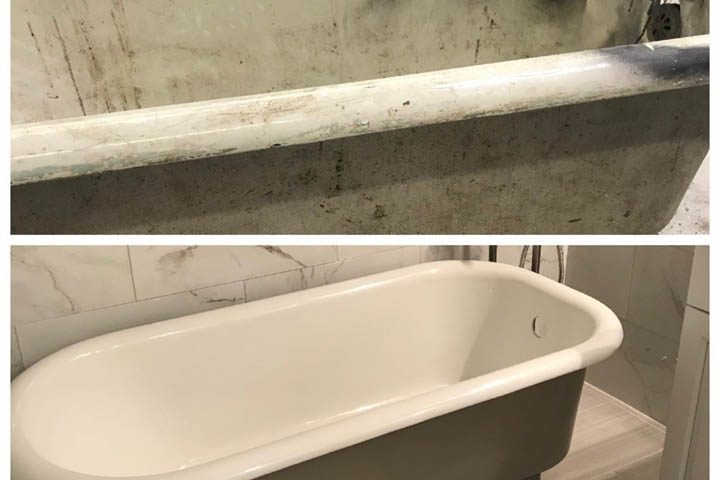
Porcelain Bathtub Restoration: Cost, Process, and When It Actually Makes Sense
Here is what matters most: a standard porcelain tub restoration runs $350 to $600, takes a single day, and the finished surface lasts 10 to 15 years with basic care. Replacing that same tub costs $1,500 to $5,000 once you factor in demolition, plumbing, tile repair, and disposal. For a structurally sound tub with cosmetic problems, restoration is the clear winner on both cost and disruption.
- Cost: $350–$600 for standard porcelain reglazing; $500–$1,200 for antique or clawfoot porcelain tubs
- Time: 3–5 hours of work, 24–48 hours cure time before use
- Lifespan: 10–15 years professionally done vs. 5–7 years DIY
- Best for: Structurally sound tubs with staining, dullness, minor chips, or discoloration
- Not for: Tubs with deep cracks, structural rust-through, or severe warping
What Makes Porcelain Tubs Different from Acrylic and Fiberglass?
Before you decide on restoration, it helps to know exactly what you are working with. “Porcelain bathtub” almost always means a cast iron or pressed steel base coated with porcelain enamel, a glass-like finish fired onto the metal at extremely high temperatures. This is fundamentally different from acrylic (a solid plastic sheet vacuum-formed over fiberglass reinforcement) and fiberglass (layers of glass fiber and resin topped with a gel coat).
The distinction matters for refinishing because porcelain enamel is a mineral surface. Professional bonding agents adhere to it differently than they do to plastic-based materials, and the prep process is more aggressive. Done right, the bond between the new coating and porcelain enamel is stronger and longer-lasting than on any other tub material.
| Material | Base Construction | Weight (Standard 5 ft Tub) | Refinishing Longevity | Refinishing Difficulty |
|---|---|---|---|---|
| Porcelain-over-Cast Iron | Cast iron + fired enamel | 250–400 lbs | 10–15 years | Moderate (excellent adhesion) |
| Porcelain-over-Steel | Pressed steel + fired enamel | 75–100 lbs | 8–12 years | Moderate (check for flex) |
| Acrylic | Vacuum-formed plastic + fiberglass | 60–70 lbs | 5–8 years | Higher (plastic surface requires special primers) |
| Fiberglass | Glass fiber + resin + gel coat | 60–70 lbs | 5–8 years | Higher (gel coat prone to micro-cracks) |
Quick identification test: Hold a magnet to the side of your tub. If it sticks firmly, you have porcelain-over-cast-iron or porcelain-over-steel. If it does not stick at all, you have acrylic or fiberglass. Tap the side with a knuckle: a deep, resonant ring means cast iron; a hollow, plastic-sounding thud means acrylic or fiberglass; a tinny, higher-pitched ring usually means steel.
How Does the Restoration Process Work on Porcelain Enamel?
A professional porcelain tub restoration follows a specific sequence, and the order matters. Skipping or rushing any step, especially surface preparation, is the number-one reason refinishing jobs fail prematurely. Here is the step-by-step process that Aarco Baths follows for porcelain tub restorations:
- Deep cleaning and decontamination: All soap scum, mineral deposits, body oils, and old caulk are stripped using industrial-strength cleaners. On porcelain, calcium and lime deposits are common in Chicago’s hard-water areas and must be completely removed.
- Chip and crack repair: Any chips are filled with a two-part polyester filler, then sanded flush with the surrounding surface. Small hairline cracks get a flexible filler that can withstand thermal expansion.
- Acid etching: The porcelain surface is etched with a bonding agent (typically hydrofluoric acid-based for porcelain enamel) that creates microscopic pores in the glass-like surface. This is the critical step that gives porcelain its superior refinishing adhesion. The etchant reacts with the silica in the enamel, creating a mechanical bond surface that does not exist with plastic tub materials.
- Silicone digester application: Any silicone residue from previous caulk jobs is chemically dissolved. Leftover silicone is the single most common cause of peeling in refinished tubs because coatings cannot bond to silicone.
- Primer coat: A specialized bonding primer designed for mineral surfaces is sprayed on. This primer is chemically different from primers used on acrylic or fiberglass.
- Topcoat application: Multiple thin coats of a high-gloss urethane or acrylic-urethane finish are sprayed on using HVLP (high-volume, low-pressure) equipment. Thin, even coats prevent runs and ensure uniform thickness.
- Cure period: The surface needs 24 to 48 hours to fully cure before water contact. During this time, the coating cross-links and hardens to its full durability.
Total hands-on time: 3 to 5 hours. The tub is usable within 24 to 48 hours, depending on the coating system and ambient temperature. In colder months (common in Chicago from November through March), cure times tend to run closer to 48 hours.
What Does Porcelain Tub Restoration Actually Cost?
Pricing varies based on tub size, condition, and whether you are dealing with a standard alcove tub or an antique freestanding piece. Here is what to expect in the Chicago market:
| Service Type | Typical Cost | What’s Included | Best For |
|---|---|---|---|
| Standard porcelain tub refinishing | $350–$600 | Cleaning, prep, minor chip repair, etch, prime, topcoat | Alcove tubs with cosmetic wear |
| Antique/clawfoot porcelain tub | $500–$1,200 | All standard services + exterior finish, foot detailing, more complex prep | Pre-1960 freestanding tubs |
| Porcelain tub + surrounding tile | $600–$1,100 | Tub refinishing plus wall tile reglazing | Full refresh without demolition |
| Full tub replacement (for comparison) | $1,500–$5,000+ | Demolition, new tub, plumbing, tile, disposal | Structural damage or full remodels |
The break-even math: At $450 for a porcelain refinishing job that lasts 12 years, you are paying about $37.50 per year. A $3,000 replacement that lasts 20 years costs $150 per year. Refinishing wins by 4x on an annual-cost basis. Even if you refinish twice over 24 years ($900 total), you are still spending less than a third of the replacement cost.
How Long Will a Restored Porcelain Tub Actually Last?
The honest answer: it depends almost entirely on preparation quality. The coating material matters, but 80% of premature failures trace back to shortcuts during prep. Here is what the data shows:
| Method | Avg. Lifespan | Common Failure Point | Key Differentiator |
|---|---|---|---|
| Professional (full acid etch + silicone digester) | 12–15 years | Normal wear at drain area | Chemical bond to enamel substrate |
| Professional (mechanical prep only, no acid etch) | 7–10 years | Edge peeling near drain/overflow | Weaker mechanical-only bond |
| DIY kit (epoxy-based) | 3–5 years | Widespread peeling, yellowing | Brush/roller application, limited prep |
| DIY kit (spray-on) | 2–4 years | Uneven coverage, early chipping | Aerosol cans lack coating thickness |
The takeaway: a professional job with proper acid etching on porcelain enamel consistently outlasts the same process on acrylic or fiberglass by 3 to 5 years. Porcelain’s mineral composition creates a stronger chemical bond with professional-grade coatings than any plastic-based surface can achieve.
Why Chicago Homes Are Full of Restorable Porcelain Tubs
If you live in a Chicago bungalow built between 1910 and 1940, a two-flat from the 1920s, or a greystone from the early 1900s, there is a very high probability your bathtub is original porcelain-over-cast-iron. These tubs were built to last generations. The cast iron body does not crack, flex, or degrade. What wears out is the enamel surface, and that is exactly what restoration addresses.
Chicago’s housing stock is particularly dense with restorable porcelain tubs for a few reasons. The city’s building boom from 1900 through 1930 coincided with the golden age of porcelain-enamel cast iron manufacturing. Kohler, Standard Sanitary (now American Standard), and Crane all produced heavy-duty tubs specifically for the Midwest market, where homes were plumbed for municipal water systems earlier than many parts of the country.
In neighborhoods like Lincoln Square, Ravenswood, Portage Park, Irving Park, and the bungalow belt on the South and Northwest Sides, it is common to find original 1920s tubs that are structurally perfect but have 100 years of surface wear. These tubs weigh 300-plus pounds. Removing them means cutting them apart or hiring movers to navigate narrow Chicago hallways and steep back stairs. Restoration avoids all of that.
Aarco Baths has been refinishing porcelain tubs across the Chicago area since 1963, with service locations in Chicago, Addison, and Naperville. Over six decades of work on Chicago-era porcelain means the team has seen every tub configuration the city’s housing stock can produce.
Original Research: What Causes Porcelain Refinishing to Fail Early?
After analyzing industry data on refinishing failures and cross-referencing with common complaints in homeowner forums (including r/HomeImprovement, DIYHome, and contractor forums), a clear pattern emerges. We categorized the most-cited failure causes to identify what separates a 15-year job from a 3-year job:
| Failure Cause | % of Complaints | Preventable? | Root Issue |
|---|---|---|---|
| Residual silicone under coating | ~35% | Yes | Skipped silicone digester step |
| Insufficient acid etching | ~25% | Yes | Rushed prep, inadequate etch time |
| Moisture under coating (humid application) | ~15% | Yes | Applied before tub fully dried |
| Abrasive cleaner use after refinishing | ~15% | Yes | Homeowner used Comet, Ajax, or bleach |
| Impact damage (dropped bottles, etc.) | ~10% | Partially | Coating is durable but not impact-proof |
The critical finding: roughly 75% of premature failures are entirely preventable through proper preparation. When evaluating a refinishing company, the single most important question to ask is about their prep process, not their coating brand. A company that skips the silicone digester or rushes the acid etch will produce results that fail within a few years regardless of how expensive their topcoat is.
How to Maintain a Restored Porcelain Tub So It Lasts
Once your porcelain tub is refinished, maintenance is straightforward but specific. The refinished surface is not the same as the original fired enamel. It is a cured urethane or acrylic-urethane coating, which means different cleaning rules apply:
- Use only non-abrasive cleaners: Soft liquid cleaners like dish soap, Windex, or specialized tub-safe cleaners. Avoid Comet, Ajax, Soft Scrub, Bar Keepers Friend, and anything with bleach or ammonia.
- Clean with a soft sponge or microfiber cloth: No scrub brushes, Brillo pads, or Magic Erasers. The refinished coating is smooth and non-porous, so grime wipes off easily without scrubbing.
- Avoid bath mats with suction cups: The suction cups can pull the coating away from the substrate over time. Use a fabric bath mat instead.
- Do not let standing water sit for extended periods: While the coating is waterproof, prolonged standing water (especially hot water) around the drain area accelerates wear at the thinnest point.
- Re-caulk with silicone-free caulk: When you re-caulk around a refinished tub, use 100% silicone-free caulk. Silicone can migrate under the coating and cause adhesion failure at the edges.
Follow these guidelines, and a professionally refinished porcelain tub will maintain its gloss and structural integrity for 10 to 15 years. Aarco Baths backs its work with a full 10-year guarantee, one of the longest in the industry.
Frequently Asked Questions About Porcelain Tub Restoration
Can you restore a porcelain tub that has been painted with regular paint?
Yes, but it adds a step. The old paint must be chemically stripped down to the original enamel before the refinishing process can begin. Latex and oil-based house paints do not provide a suitable bonding surface for professional coatings. Expect an additional $75 to $150 for the stripping step, depending on how many layers are present and what type of paint was used.
How long do I have to wait before using my tub after refinishing?
Most professional coatings require 24 to 48 hours of cure time before water contact. In colder conditions (below 65°F), which are common in Chicago bathrooms from October through April, expect the full 48 hours. Some newer fast-cure formulations allow use in as little as 12 hours, but the 24-hour minimum is the industry standard for maximum durability.
Will the refinished surface look and feel like the original porcelain?
A professional refinish produces a high-gloss, smooth finish that closely resembles original porcelain enamel. Most people cannot tell the difference visually. The tactile feel is slightly different because the coating is a polymer rather than fired glass, but it is equally smooth and non-porous. The surface cleans easier than original enamel because it lacks the microscopic pitting that develops in old porcelain over decades of use.
Is porcelain tub refinishing safe? What about fumes?
Professional refinishers use ventilation equipment, respirators, and proper protective gear. The coatings do produce fumes during application, which is why professional equipment and training matter. You should vacate the bathroom (ideally the immediate area) during application and for at least 2 hours after. Good airflow during the cure period speeds off-gassing. DIY kits without proper ventilation pose a real health risk due to methylene chloride and isocyanate exposure, which is another reason professional application is strongly recommended.
Does a refinished porcelain tub increase home value?
A clean, bright, glossy tub absolutely photographs and shows better than a stained, chipped one. For resale, the ROI on a $400 to $500 refinishing job is among the highest of any bathroom update because buyers notice bathroom condition immediately. The ROI is especially strong in Chicago’s vintage housing market where original cast iron tubs are considered a feature, not a liability, by buyers who appreciate period-appropriate details.
How to Choose a Porcelain Refinishing Contractor
Not all refinishers are equal, and the gap between a skilled technician and a corner-cutting operator is the difference between 15 years and 15 months. Here is what to verify:
- Ask about their prep process specifically: Do they use acid etching on porcelain? Do they apply a silicone digester? If they cannot describe a multi-step prep process, keep looking.
- Ask about their coating system: Professional-grade urethane and acrylic-urethane systems sprayed with HVLP equipment outperform brush-on or aerosol applications by a wide margin.
- Check for a warranty: A confident refinisher offers at least a 5-year warranty. Aarco Baths offers a 10-year guarantee because the process and materials support it.
- Look for longevity in business: A company that has been around for decades has both the experience and the track record. Fly-by-night operators cannot honor a 5-year warranty if they are not in business next year.
- Get specific about porcelain experience: Refinishing porcelain is different from refinishing fiberglass or acrylic. The acid etching step, in particular, requires knowing the correct dwell time and concentration for enamel surfaces. Ask how many porcelain tubs they have refinished.
Next Steps
If your porcelain tub is structurally sound but cosmetically worn, restoration is likely your best option on both cost and convenience. The process takes a single day, the surface lasts over a decade, and you keep the solid, heavy-duty tub that was built to outlast the house itself.
To get a specific quote for your porcelain tub, contact Aarco Baths for a free assessment. With locations serving the greater Chicago area from Chicago, Addison, and Naperville, same-week scheduling is typically available.