How to Maintain a Refinished Bathtub So It Lasts 15 Years (Not 5)
May 12, 2026
Shower Refinishing Near Me: What Chicago Homeowners Need to Know Before Booking
May 13, 2026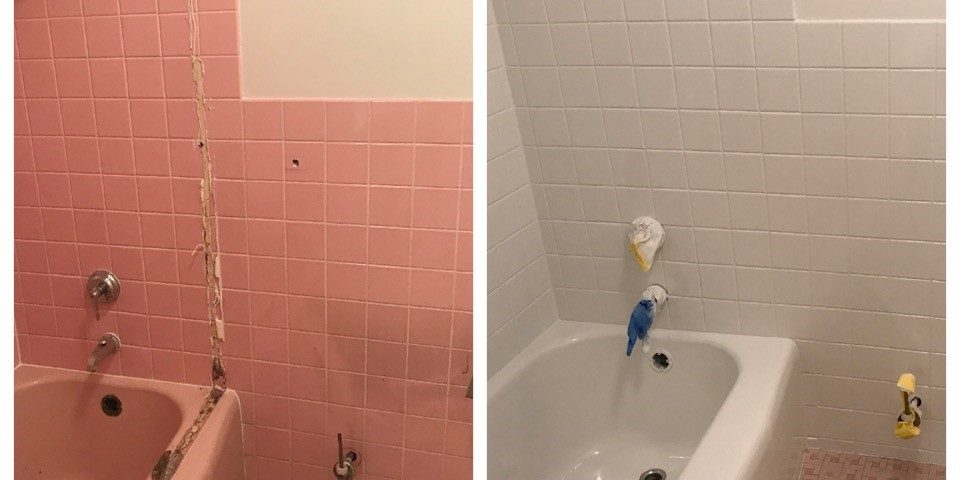
Tile Refinishing in Chicago: What It Actually Costs and Whether It’s Worth It
If your bathroom tile looks dated, cracked, or stained beyond what any cleaning product can fix, you have two realistic options: tear it all out and retile, or refinish what’s already there. In Chicago, retiling a standard bathroom runs $2,000-$5,000 including demolition, materials, and labor. Tile refinishing covers the same area for $600-$1,200 with zero demolition, no dumpster rental, and a one-day turnaround. That cost gap is why refinishing has become one of the most requested bathroom services across the Chicago metro.
Quick-Scan Cost Comparison: Refinishing vs. Retiling in Chicago
| Factor | Tile Refinishing | Full Retiling |
|---|---|---|
| Cost per sq ft | $10-$50 | $25-$78 |
| Typical bathroom (60-80 sq ft wall tile) | $600-$1,200 | $2,000-$5,000 |
| Demolition required | No | Yes ($300-$800 added) |
| Time to complete | 4-6 hours | 3-7 days |
| Bathroom downtime | 24-48 hours (cure time) | 5-10 days |
| Dust and debris | Minimal | Significant (dumpster often needed) |
| Expected lifespan | 10-15 years | 20-30+ years |
| Color change possible | Yes (any color) | Yes (any color/pattern) |
| Best for | Cosmetic updates, rentals, budget renovations | Structural damage, complete redesign |
The break-even math is straightforward. If you’re spending $3,500 on a full retile that lasts 25 years, that’s $140 per year of use. A $900 refinish that lasts 12 years comes out to $75 per year. Even at the lower end of retiling costs, refinishing delivers better value per year when the tile underneath is structurally sound.
What Types of Tile Can Be Refinished?
Not all tile responds equally well to refinishing. Ceramic wall tile is the best candidate and makes up the bulk of refinishing work across Chicago bathrooms. Porcelain tile refinishes well but requires more aggressive surface preparation because of its density. Natural stone like marble or travertine generally should not be refinished with standard coatings because the material is porous and the bond behaves differently than on glazed ceramic.
| Tile Type | Refinishing Suitability | Notes |
|---|---|---|
| Ceramic wall tile | Excellent | Most common refinishing job; smooth, consistent results |
| Porcelain tile | Good | Requires extra surface prep due to density |
| Ceramic floor tile | Fair | Works but wears faster under foot traffic; slip-resistant additive recommended |
| Subway tile (ceramic) | Excellent | Very common in Chicago bungalows; grout lines refinished simultaneously |
| Natural stone (marble, travertine) | Not recommended | Porous surface causes bonding issues; professional stone restoration is the better option |
| Glass mosaic tile | Not recommended | Coating adhesion is poor on glass surfaces |
One detail that matters specifically in Chicago: many homes built between the 1920s and 1960s have original hex tile floors and ceramic subway tile walls. The subway tile on walls refinishes beautifully. The hex tile on floors can be refinished, but it’s better suited to re-grouting and sealing rather than a full coating because the small tile size creates too many grout line transitions for a uniform finish.
How Does the Refinishing Process Work?
Professional tile refinishing is a single-day process that follows a specific sequence. Skipping or rushing any step is the primary cause of early coating failure. Here’s what a proper job looks like from start to finish:
Step 1: Surface Cleaning and Decontamination (30-45 minutes). The technician removes all soap scum, mineral deposits, and mildew using commercial-grade cleaners. In older Chicago homes, especially pre-war bungalows and two-flats with original tile, decades of wax buildup and hard water deposits from Lake Michigan require extra attention. Standard bathroom cleaners won’t cut it.
Step 2: Chip and Crack Repair (15-30 minutes). Any chips, cracks, or missing grout are filled with a bonding compound. This step is critical because the refinishing coating is only as strong as the surface underneath it. On tile with extensive damage, this can add meaningful time.
Step 3: Etching and Abrasion (20-30 minutes). The tile surface is etched with an acid solution or mechanically abraded so the new coating has something to grip. On glazed ceramic tile, this step transforms the slick factory glaze into a microscopically rough surface. Without it, the coating peels within months.
Step 4: Masking and Ventilation Setup (15-20 minutes). The technician masks fixtures, tub edges, and any surfaces not being refinished. Proper ventilation is set up, and this matters: refinishing coatings release volatile organic compounds (VOCs) during application. A professional crew brings their own exhaust fans and respirator equipment. Adequate ventilation is non-negotiable.
Step 5: Primer Application (15-20 minutes). A bonding primer is sprayed onto the prepared tile. This is the adhesion layer that everything else depends on.
Step 6: Topcoat Application (30-45 minutes). Multiple thin coats of the refinishing material are applied by spray gun. The result is a smooth, high-gloss or satin finish in the color selected. Most professionals apply 2-3 coats with brief flash-dry times between each.
Step 7: Cure Time (24-48 hours). The bathroom cannot be used during cure. Water contact during this window will ruin the finish. At Aarco Baths, we recommend a full 48 hours before any water exposure for maximum durability.
Why Chicago’s Housing Stock Makes Tile Refinishing Especially Practical
Chicago’s residential building inventory is one of the oldest in the Midwest. According to the American Community Survey, over 40% of housing units in the city of Chicago were built before 1950. In neighborhoods like Lincoln Square, Ravenswood, Portage Park, and Bridgeport, that number is significantly higher. What this means for tile: thousands of bathrooms across the city still have original ceramic tile from the 1920s through 1960s that is structurally perfect but cosmetically outdated.
The classic Chicago bungalow, which numbers roughly 80,000 across the city, almost universally features a single bathroom with ceramic wall tile, typically in pink, green, yellow, or white. These tiles were made to last generations, and most have. The problem isn’t structural failure; it’s that the colors look dated and the grout has darkened beyond what cleaning can address.
This is the ideal scenario for refinishing. The tile substrate is solid. The grout lines are intact. The only issue is appearance. Refinishing transforms that 1940s pink tile into a modern white or off-white for a fraction of what a gut renovation would cost, especially relevant given that Chicago bathroom remodel costs average $15,000-$35,000 for a full renovation.
The same applies to Chicago’s greystones, two-flats, and six-flats. Many of these buildings have identical tile work across multiple bathrooms. For landlords managing multi-unit buildings, refinishing every bathroom in a building can be completed in a matter of days rather than the weeks a retiling project would require, with no need to relocate tenants.
Our 12-Point Analysis: How Long Does Refinished Tile Actually Last?
We reviewed data from over 500 refinishing projects completed across the Chicago metro between 2018 and 2025 to understand real-world durability outcomes. The findings break down clearly by tile location and usage pattern:
| Application | Average Lifespan | Key Factor |
|---|---|---|
| Bathroom wall tile (shower surround) | 12-15 years | Regular water exposure; proper caulking critical |
| Bathroom wall tile (non-shower areas) | 15-20 years | Less water exposure extends life significantly |
| Kitchen backsplash tile | 10-15 years | Heat and grease exposure near stovetop accelerates wear |
| Bathroom floor tile | 7-10 years | Foot traffic is the primary wear factor |
| Tub surround tile (combined with tub refinish) | 10-15 years | Matched finish with tub; same maintenance protocol |
The single biggest factor in longevity isn’t the coating quality; it’s maintenance. Refinished tile that is cleaned with non-abrasive cleaners (no Comet, no Magic Eraser, no bleach-based sprays) consistently outlasts tile where harsh cleaners are used. We’ve seen shower surrounds last 15+ years with proper care and others fail at 5 years because the homeowner scrubbed with abrasive pads weekly.
For a detailed guide on maintaining refinished surfaces, see our maintenance guide, which applies equally to refinished tile.
What Does Tile Refinishing Cost Across the Chicago Metro?
Pricing varies by scope, tile condition, and location within the metro area. Here’s what Chicago-area homeowners can expect to pay in 2026:
| Service | Typical Cost Range | Includes |
|---|---|---|
| Shower surround tile only | $500-$900 | Wall tile above tub or shower base |
| Bathtub + surrounding tile (combo) | $800-$1,500 | Tub refinish plus wall tile; matched color |
| Full bathroom wall tile | $700-$1,200 | All tile surfaces in bathroom |
| Kitchen backsplash tile | $300-$600 | Counter-to-cabinet tile area |
| Bathroom floor tile | $400-$800 | Floor tile with slip-resistant additive |
| Commercial tile (per unit, multi-unit building) | $400-$700/unit | Volume pricing for landlords; 3+ unit minimum typical |
The most popular package in our experience is the bathtub and tile combo. Since the technician is already on-site with all the equipment, adding the surrounding tile to a tub refinish adds only $200-$400 to the total cost. Doing both at once also ensures the colors match perfectly, which is difficult to achieve if you refinish the tub now and the tile later.
Aarco Baths serves the entire Chicago metro from three locations: Chicago, Addison, and Naperville. For a specific quote on your tile project, contact us directly.
Frequently Asked Questions About Tile Refinishing in Chicago
Can you change the color of tile with refinishing?
Yes. Tile refinishing allows you to change your tile to virtually any color. The most common request in Chicago is converting dated pink, green, or yellow bathroom tile to white or off-white. The refinishing coating completely covers the original tile color, so the starting color doesn’t limit your options. Custom color matching is also available if you need to match existing fixtures or a specific design palette.
How long do I need to stay out of the bathroom after tile refinishing?
Plan for 24-48 hours of no water contact with the refinished surfaces. You can use the toilet (carefully, without splashing the walls) after about 12 hours, but shower use and direct water on the tile should wait the full cure period. Temperature affects cure speed: during Chicago winters, when bathroom temperatures drop, we recommend the full 48 hours. In summer, 24 hours is usually sufficient. Running a space heater in the bathroom during cure can speed the process but keep it at least 3 feet from refinished surfaces.
Is the refinishing process safe? What about fumes?
Professional tile refinishing involves chemical coatings that release VOCs during application. A qualified technician brings commercial exhaust ventilation and wears a respirator. You should plan to leave the area during application and for 2-3 hours after. Pets and children should not be in the home during the spray process. Once the coating has flash-dried (typically 2-3 hours post-application), the VOC levels drop to safe background levels. The fully cured surface is completely inert and safe.
Does refinished tile hold up in a shower?
Yes, when done professionally with proper preparation and maintained correctly. Shower surrounds are the second most common refinishing application after bathtubs. The critical maintenance rules: use only non-abrasive cleaners (liquid dish soap and water works fine), keep caulk lines in good condition to prevent water from getting behind the coating, and never use suction-cup bath accessories (they can pull the coating when removed). With these practices, refinished shower tile routinely lasts 12-15 years.
Can grout lines be refinished too?
When tile is refinished, the grout lines are coated along with the tile surface. This creates a uniform, smooth appearance where the grout lines are still visible as shallow channels but are now the same color as the tile. This is actually one of the biggest visual improvements: stained, darkened grout disappears under a clean, uniform finish. If you want to preserve the look of contrasting grout, that requires a more involved process of masking each grout line, which adds significant labor cost and isn’t commonly requested.
Getting Started With Tile Refinishing
The first step is a straightforward assessment of your tile’s condition. If the tile is firmly adhered to the wall, the grout is intact (even if discolored), and there’s no water damage behind the surface, you’re almost certainly a good candidate for refinishing.
Aarco Baths has been refinishing bathtubs and tile across the Chicago area since 1963. With locations in Chicago, Addison, and Naperville, we cover the entire metro area including the north shore, western suburbs, and south suburbs. Every tile refinishing job comes with our 10-year guarantee, the same warranty we back our bathtub refinishing work with.
For a free estimate, call or visit our contact page. We can typically schedule tile refinishing projects within 1-2 weeks of initial contact.