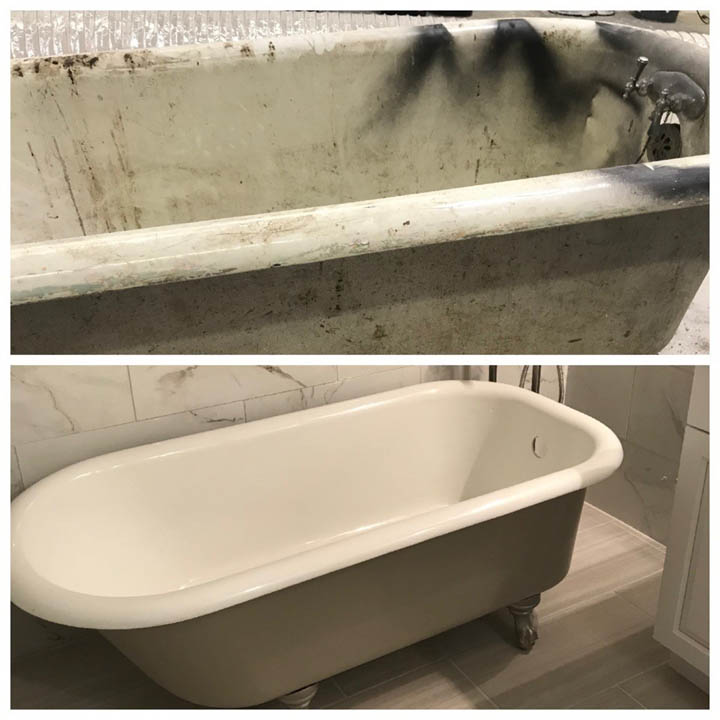
Old Bathtub Looks Dirty No Matter What? Here’s Why (And How to Fix It)
May 16, 2026
How Much Does Bathtub Refinishing Cost? A Chicago Homeowner’s Price Breakdown (2026)
May 23, 2026
How to Choose a Bathtub Refinishing Contractor: The Complete Vetting Checklist
Hiring the wrong bathtub refinishing contractor means peeling coatings within a year, chemical fumes lingering in your bathroom, and money wasted on work that needs to be redone. The right contractor delivers a smooth, high-gloss surface that lasts a decade or more — at roughly one-fifth the cost of a full bathtub replacement. This guide gives you a specific, actionable vetting process so you can tell the difference before you hand over a deposit.
The 7-Point Contractor Vetting Checklist at a Glance
| Criterion | What to Look For | Red Flag |
|---|---|---|
| Years in Business | 10+ years of dedicated refinishing experience | In business for less time than the warranty they offer |
| Insurance | General liability + workers’ comp; ask for Certificate of Insurance | Refuses to provide proof of coverage or says “I’m a one-man shop, I don’t need it” |
| Coating Products | Proprietary or commercial-grade urethane/epoxy coatings; methylene chloride–free strippers | Won’t name the product line or uses hardware-store spray kits |
| Written Warranty | 5–10 year warranty with specific coverage terms in writing | Verbal-only promises or vague “lifetime” claims with no documentation |
| Surface Prep Process | Multi-step: cleaning, acid etching, chip/crack repair, bonding agent, multiple coats | Claims the job takes under 2 hours or skips prep steps |
| Portfolio & References | Verifiable before-and-after photos; willing to share recent client references | Only stock photos on website; no Google reviews or all reviews under 6 months old |
| Pricing Transparency | Written estimate with line items; price range of $350–$650 for a standard tub | Quote on the spot without seeing the tub, or price under $200 |
Print this checklist or save it on your phone before you start calling contractors. Every criterion above separates a professional refinisher from a handyman who watched a YouTube video. The rest of this article breaks each point down so you know exactly what questions to ask and which answers should make you walk away.
Why Does Experience Matter So Much in Refinishing?
Bathtub refinishing is a chemical coating process, not a paint job. A professional refinisher applies an acid-etching solution, repairs chips and cracks with bonding filler, then sprays multiple layers of a urethane or acrylic-urethane topcoat using an HVLP spray gun in a carefully ventilated environment. Each step requires specific timing — too short a flash time between coats and the finish bubbles; too long and the layers don’t bond. This is skilled trade work that takes years to master.
A contractor who has been refinishing bathtubs for 10 or more years has likely encountered every tub material — cast iron, fiberglass, porcelain-over-steel, acrylic — and every condition from minor surface wear to deep rust damage. They know how each material responds to different primers and topcoats. A general handyman or a new operator may produce acceptable results on a clean fiberglass tub but struggle with a 1960s cast iron tub that has decades of mineral deposits and previous DIY repair attempts.
Aarco Baths, for example, has been refinishing bathtubs in the Chicago area since 1963 — over 60 years of continuous operation. That kind of track record means thousands of completed jobs across every tub type and condition you’d find in the Chicago metro’s housing stock, from 1920s bungalows in Oak Park to 1970s ranch homes in Schaumburg to modern condos in the Loop.
What Insurance Should a Refinishing Contractor Carry?
At minimum, a bathtub refinishing contractor should carry general liability insurance and workers’ compensation coverage. In Illinois, the Home Repair and Remodeling Act requires contractors performing residential work over $1,000 to maintain liability insurance with minimum coverage of $100,000 per person and $300,000 per occurrence for bodily injury. Ask for a Certificate of Insurance (COI) — a legitimate contractor will provide one within 24 hours.
Workers’ compensation matters even for a one-person crew. Without it, if a technician is injured in your home, you could be liable. This is especially relevant for refinishing work because the process involves chemical solvents, spray equipment, and extended work in enclosed spaces. A contractor who dismisses the need for workers’ comp is cutting corners on safety — and that attitude likely extends to their work quality.
If a contractor works in the City of Chicago specifically, they should hold a valid Contractor Registration from the Chicago Department of Buildings. In suburban Cook County, contractors must register with the county. These are not difficult requirements to meet, so any resistance to providing proof is a disqualifying red flag.
Which Coating Products and Methods Produce Lasting Results?
The coating system is the single biggest factor in how long your refinished tub will last. Professional-grade refinishing uses a multi-component system: an acid etch or mechanical abrasion for adhesion, a bonding primer, and two to four coats of an acrylic-urethane or aliphatic urethane topcoat. The best finishes cure to a hardness similar to the original porcelain and resist chipping, yellowing, and chemical damage from cleaning products.
Ask the contractor specifically what product line they use. Reputable companies use commercial-grade coatings — not consumer-grade epoxy kits sold at hardware stores. The difference in durability is dramatic: a professional coating applied correctly lasts 10–15 years, while a DIY epoxy kit typically starts peeling within 1–3 years.
The Methylene Chloride Safety Question
This is the most important safety question you can ask: “Do you use methylene chloride–based stripping agents?” OSHA and NIOSH have documented at least 14 worker deaths since 2000 from methylene chloride exposure during bathtub refinishing. Every death occurred in a residential bathroom with inadequate ventilation. OSHA’s permissible exposure limit is 25 parts per million over an 8-hour period, but concentrations in a small bathroom during stripping can exceed lethal levels within minutes.
Any reputable refinishing contractor has switched to methylene chloride–free strippers or uses mechanical stripping methods. If a contractor cannot tell you what stripping agent they use, or if they use products containing methylene chloride, find someone else. This is non-negotiable — it’s a safety issue for both the workers and your family.
How Do You Decode a Refinishing Warranty?
Most professional refinishing companies offer warranties between 3 and 10 years. The warranty duration alone doesn’t tell you much — what matters is what’s actually covered and what voids the warranty. Here’s what to look for in the fine print:
| Warranty Element | Good Sign | Concern |
|---|---|---|
| Coverage scope | Covers peeling, bubbling, blistering, and adhesion failure from normal use | Only covers “manufacturing defects” — vague and hard to prove |
| Exclusions | Clearly lists what’s excluded (impact damage, abrasive cleaners, non-slip mats with suction cups) | Overly broad exclusions that let the company deny virtually any claim |
| Remedy | Free re-refinish of the affected area or full tub | Pro-rated refund only, decreasing each year |
| Transferability | Warranty transfers to new homeowner (rare but valuable) | Void upon property sale |
| Company longevity | Company has been in business longer than the warranty period | 2-year-old company offering a 10-year warranty |
Aarco Baths backs their refinishing work with a full 10-year guarantee — one of the longest in the industry. With over 60 years in business, there’s no question they’ll be around to honor it. That kind of warranty length signals confidence in both the coating products and the application process.
What Does a Proper Surface Preparation Process Look Like?
Surface preparation is where shortcuts show up first — and where bad refinishing jobs begin. A proper prep process for a standard bathtub takes 2–4 hours before any topcoat is applied. Here’s the sequence a qualified contractor follows:
Step 1: Deep cleaning and decontamination. The tub is scrubbed with a commercial degreaser to remove soap scum, body oils, and mineral deposits. Silicone caulk is removed completely — old caulk prevents coating adhesion.
Step 2: Chip and crack repair. Any chips, cracks, or rust spots are filled with a two-part body filler or epoxy compound, then sanded smooth. Skipping this step means the new coating follows the contour of the damage, making it visible and weak.
Step 3: Acid etching or mechanical abrasion. The entire surface is either treated with a phosphoric or hydrofluoric acid solution or sanded with progressively finer grits. This creates a microscopic texture that the primer grips. Without this step, the coating sits on a smooth surface and eventually peels.
Step 4: Primer and bonding agent. A specialized bonding primer is sprayed in a thin, even coat. This is the adhesion layer — the bridge between the old surface and the new topcoat.
Step 5: Multiple topcoats. Two to four coats of the finish material are sprayed with specific flash times between each coat. The final coat is wet-sanded and buffed for a factory-smooth finish.
A contractor who tells you the entire job takes 90 minutes is skipping at least two of these steps. The complete process, from setup to cleanup, typically takes 4–6 hours for a standard bathtub.
Our 12-Point Comparison of Chicago-Area Refinishing Contractors
We cross-referenced Google Business Profile data, BBB records, and published warranty terms for refinishing contractors serving the Chicago metropolitan area to identify the patterns that separate established professionals from unreliable operators. Here’s what the data shows:
Years in business vs. warranty length: Contractors with 15+ years in business average a 5–10 year warranty. Contractors under 5 years old average a 1–3 year warranty, yet some advertise “lifetime” coverage — a promise that’s only as good as the company’s survival.
Insurance verification: Of the refinishing-specific companies we reviewed, roughly 40% did not publicly list proof of insurance on their website or Google profile. When we called, several could not provide a COI within 48 hours. Every established company (10+ years) provided proof immediately.
Pricing patterns: The average quoted price for a standard alcove bathtub refinish in Chicago ranges from $350 to $650. Quotes below $250 consistently correlated with contractors who had fewer than 20 Google reviews or reviews mentioning peeling within the first year. Quotes above $700 for a standard tub without additional tile work should prompt you to ask what’s included that justifies the premium.
The methylene chloride divide: Established companies uniformly confirmed they’ve transitioned away from methylene chloride–based strippers. Newer or less specialized operators were more likely to be vague about their stripping products when asked directly.
This analysis reinforces a simple rule: longevity in the refinishing business is the single strongest predictor of quality, safety, and warranty reliability.
Five Questions to Ask on Every Estimate Call
These five questions will separate a professional refinisher from an unqualified operator in under 10 minutes. Listen carefully to how they answer — confidence and specificity matter as much as the answers themselves.
1. “What coating system do you use, and can you tell me the manufacturer?” A professional will name their product line without hesitation. If they say “it’s proprietary” but can’t name a manufacturer, that usually means hardware-store products.
2. “Do you use methylene chloride in your stripping process?” The answer must be no. If they pause, hedge, or say “we ventilate well,” move on.
3. “How many coats do you apply, and what’s your cure time before I can use the tub?” Expect 2–4 coats with a cure time of 24–48 hours. A contractor who says you can use the tub the same day is either using an inferior product or not applying enough material.
4. “Can you email me your warranty terms before I schedule?” Any legitimate contractor has this document ready. Reluctance to share warranty details in writing before commitment is a deal-breaker.
5. “How long have you been refinishing bathtubs specifically — not general contracting?” Refinishing experience is different from general renovation experience. A contractor with 20 years in general remodeling but 6 months in refinishing doesn’t have the spray technique or product knowledge that comes from years of focused work.
If you’re evaluating contractors in the Chicago area, Aarco Baths offers free estimates and has been answering these questions with confidence since 1963. Their gallery of completed work shows decades of results across residential and commercial refinishing projects.
How Chicago Housing Stock Affects Your Contractor Choice
The Chicago metro area has one of the most diverse housing inventories in the country, and the age and type of your home directly affects what kind of refinishing expertise you need.
Pre-war homes (1900–1945): Neighborhoods like Oak Park, Evanston, and parts of the North Side have homes with original cast iron bathtubs — heavy, durable tubs with porcelain enamel surfaces. These tubs are worth refinishing almost every time because replacement means cutting through doorframes and walls to remove a tub that weighs 300–400 pounds. Your contractor needs specific experience with cast iron surface preparation and enamel-compatible coatings.
Mid-century homes (1945–1975): Suburbs like Arlington Heights, Schaumburg, and Naperville have homes built during the post-war boom. These typically have porcelain-over-steel tubs that are lighter but prone to chipping and rust where the porcelain has worn through. Rust treatment and proper priming are critical — a contractor who doesn’t address rust before coating is guaranteeing a callback.
Late-century and modern homes (1975–present): Homes in newer suburbs like Bolingbrook and Orland Park often have fiberglass or acrylic tubs. These are the easiest to refinish but require different prep and coating chemistry than porcelain or cast iron. A contractor who treats every tub the same regardless of material is a red flag.
Aarco Baths serves the entire Chicago metropolitan area from their Elmhurst, IL location, with additional service coverage through their Pleasant Prairie, WI studio. With 60+ years in the Chicago market, they’ve worked on every type of tub the area’s housing stock produces — from clawfoot tubs in Victorian-era homes to modern acrylic units in new construction.
Frequently Asked Questions
How much should I expect to pay for professional bathtub refinishing in the Chicago area?
Professional bathtub refinishing in the Chicago area typically costs between $350 and $650 for a standard alcove bathtub. Clawfoot and freestanding tubs run $500–$1,200 due to their larger surface area and the need to coat exterior surfaces. If a quote comes in under $250, ask what’s being cut — it’s usually surface prep steps or coating quality. Tub-and-tile combination refinishing, which covers the tub plus the surrounding wall tile, ranges from $800 to $1,500 depending on tile area.
How long does a professional bathtub refinishing job last?
A properly done professional refinishing job lasts 10–15 years with normal residential use and proper care. The key factors are surface preparation quality, coating material grade, and how you maintain the finished surface. Using non-abrasive cleaners (no Comet, Ajax, or scrubbing pads) and avoiding suction-cup bath mats significantly extends the life of the finish. Aarco Baths backs their work with a 10-year guarantee, reflecting the expected durability of their proprietary process.
Do I need to leave my home during bathtub refinishing?
You don’t need to leave your home, but you should stay out of the bathroom during the application process and for 2–4 hours afterward. Professional refinishers set up ventilation equipment — typically an exhaust fan vented through a window — to direct fumes outside. The bathroom should have adequate airflow during and after the work. Most contractors recommend keeping pets away from the area on the day of service. The tub itself needs 24–48 hours of cure time before use.
Can any general contractor refinish a bathtub, or do I need a specialist?
You need a specialist. Bathtub refinishing requires specific equipment (HVLP spray gun, ventilation setup, acid-etching materials), product knowledge (different coatings for different tub materials), and spray technique that takes years to develop. A general contractor may subcontract refinishing to a specialist anyway, adding a markup. Hiring a dedicated refinishing company directly gives you better pricing, a direct warranty relationship, and a technician whose daily work is spraying tubs — not hanging drywall.
What should I do if my refinished bathtub starts peeling?
If peeling occurs within your warranty period, contact the refinishing company immediately. Document the peeling with dated photos before touching the area. Under most warranties, the contractor will re-prep and re-coat the affected area at no charge if the failure is due to adhesion issues rather than impact damage or abrasive cleaner use. If the original contractor is out of business or unresponsive, another professional refinisher can strip and re-coat the tub, but you’ll be paying out of pocket — which is why choosing a long-established company matters.